|
|

The
invention of Bill rutland, reporter, Born Macon
Georgia, 1900. Died edinburgh, scotland, 1994,
active with
Green scarf stories
from 1929
until hounded by the McCarthy trials for suggesting
it was not safe for American troops to fight in a
nuclear -- heavy fallout -- battlefield. In 1952 to
suggest Us troops were vulnerable and that nuclear
war implied problems was a breach of national
security.
(This latter owes a debt
to Eileen Welsome: The Plutonium Files, 1999).
Summary:
He always wore his green scarf, or one of them, even at night.
Rutland was shy, with people, about
getting his writing published.
Living hand to mouth, crossing the
whole American continent on foot, working here and
there, getting involved with bird population studies
and ancient tree recording, twice a woman asked him
if she could wear his green scarf.
He retained little of his southern
heritage. He kept his soft accent and, he hoped, his
courtesy. He always wanted to say 'if you wear
nothing else' and never dared.
Then he met Melinda Fellowes. She and
her father owned and published a string of western
newspapers, mainly in farm districts and small
towns.
She liked what she saw of his
writing on the near extinct Ivory Billed Woodpecker
and the fast removal of virgin forests from the USA.
'May I wear your green
scarf?' she asked.
'Yes,' he said. 'Of
course.'
'That is not the correct
response,' she said.
'Oh?' he asked. 'What
is?'
'If you wear nothing
else,' she said.
'You may wear my green
scarf if you wear nothing else,' he said, confident
this was a trick.
It was not a
trick. He became her mistress, that is he only made
love to her when invited. She became his editor.
|
|
|
|
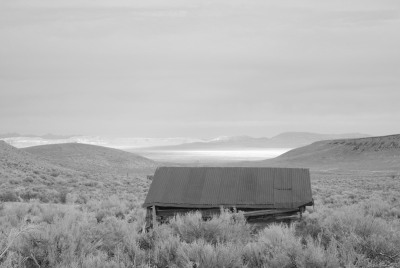
Bill
Rutland's cabin in the desert north of Reno, Nevada, where
he and Melinda Fellowes thought up the good science/bad science
idea that led to the Green Scarf Stories column.
|
 Edgar
Fellowes jr was born in 1870 on a dairy farm close
to the growing port of Seattle Washington. He edited
his school newspaper and dreamed of owning his own
newspaper in a farm community. In 1895 he met the
family of Samuel Forth, an Englishman buying real
estate in the new city. He 'rescued' Forth's
daughter Harriet who needed to escape her father's
regime of strict Presbyterianism and stricter money
making at any cost. So Harriet Forth stayed west,
married Fellowes and used some of her own wealth to
start a small newspaper. Melinda Fellowes was born
in 1895 and her mother died of sepsis at the birth
of a second child. Edgar Fellowes accumulated farm
community papers and his daughter worked as an
editor from the age of fourteen. In 1923, Henry Luce
who was younger than Melinda and much younger than
Edgar Fellowes, started TIME whose character was to
boost American achievement. Edgar
Fellowes jr was born in 1870 on a dairy farm close
to the growing port of Seattle Washington. He edited
his school newspaper and dreamed of owning his own
newspaper in a farm community. In 1895 he met the
family of Samuel Forth, an Englishman buying real
estate in the new city. He 'rescued' Forth's
daughter Harriet who needed to escape her father's
regime of strict Presbyterianism and stricter money
making at any cost. So Harriet Forth stayed west,
married Fellowes and used some of her own wealth to
start a small newspaper. Melinda Fellowes was born
in 1895 and her mother died of sepsis at the birth
of a second child. Edgar Fellowes accumulated farm
community papers and his daughter worked as an
editor from the age of fourteen. In 1923, Henry Luce
who was younger than Melinda and much younger than
Edgar Fellowes, started TIME whose character was to
boost American achievement.
Melinda dreamed of a rival. They would call it
NOW! and it would advocate for those trapped on
the dark side of the American dream. Bill Rutland
would be one of her writers.
 'Science', her father asked?
'A column about science?'. In 1929 with no money in
the stock market at the time of the crash, father
and daughter moved fast. They bought an office in
Philadelphia, another, smaller on in Washington, and
a bankrupt printing press in Kansas City -- good for
weekly distribution, close to the middle of the USA.
'Science', her father asked?
'A column about science?'. In 1929 with no money in
the stock market at the time of the crash, father
and daughter moved fast. They bought an office in
Philadelphia, another, smaller on in Washington, and
a bankrupt printing press in Kansas City -- good for
weekly distribution, close to the middle of the USA.
Before this, from time to time, Rutland and Melinda
trekked on ponies to a rusty cabin with a spring in
the Nevada high desert. A mule bought a bed in
parts, a mattress and linen. Suspecting this soon
after the establishment of NOW!, Edgar
Fellowes sent a sheriff's deputy and a cowboy to
arrest them for fornication -- not a crime, but who
cares? 'Green Scarf Stories', she said to him as the
men broke in. The two were wearing nothing else. The
men whipped Rutland, locked the padlock on the cabin
and shut him out naked and bruised. They took the
horses to Reno and the daughter back to
Philadelphia.
She
pleaded with her father. The good and bad side of
science, of progress, of what people want. Oil but
oil pollution? An expanding lumber industry, yet
with no virgin trees left? Cheap cars with grim
conditions for the workforce? He agreed to the Green
Scarf Stories column, three pages from the back of
the weekly magazine. One condition. He sent Rutland
money for a suit and a train ticket east. He wore
the suit, also tan boots and the green scarf, a
beautiful one of webbed cotton. 'You put your pecker
in my daughter's sacred thing, Rutland?' 'No, sir,
never.' 'My men dragged you out naked?' 'No, sir,
that was to get the bonus you offered them.' 'You
promise, Rutland?' 'Yes, sir, the truth.'
If Rutland bent the truth to find favor with a
widower dependent on his daughter's affection, so be
it.
On the whole the Green Scarf Stories told the truth.
It soon grew a big mail bag and was moved forward in
the weekly, expanded to 2000 words an issue,
uncovered science scandals in the oil industry and
pharmaceuticals, described advances in biochemistry
and atomic physics, covered the exile of Jewish
scientists by the Nazis before the US press paid
attention to the Nazis, warned that a coming war
might be won by the side with the newest scientific
weapons.
Green Scarf Stories
Inside
Green Scarf Stories:
The
first green scarf novel starts at the point rutland
writes of the danger that a new war may be won by
weapons not yet invented at its start:
Read the excerpt>>>>
|
|
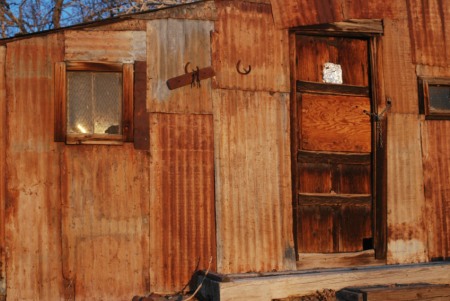
She
furnished it with a bed, maTtress and Irish linen
and wrote
in green
paint the words Green Scarf Stories
on a mirror
tilted so that she could watch him undress off the
only room. tHE
NAKED RUTLAND WAS HER GREEN SCARF sTORY.
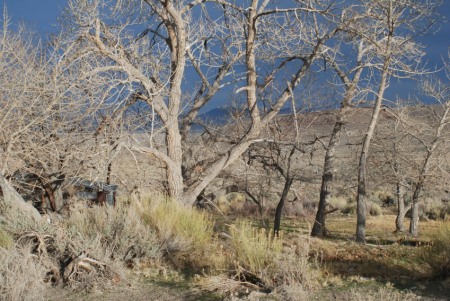
The
rusty cabin is just visible centre left. The small
dark and authoritative editor was not so much
Rutland's only story as a haven to assuage his lust
and forget his cares. And pay him to write.
>>> more |
|
|
|
|